In this article
- Why the question keeps coming up
- Off-the-shelf ERP: what you actually get
- What a custom ERP system really involves
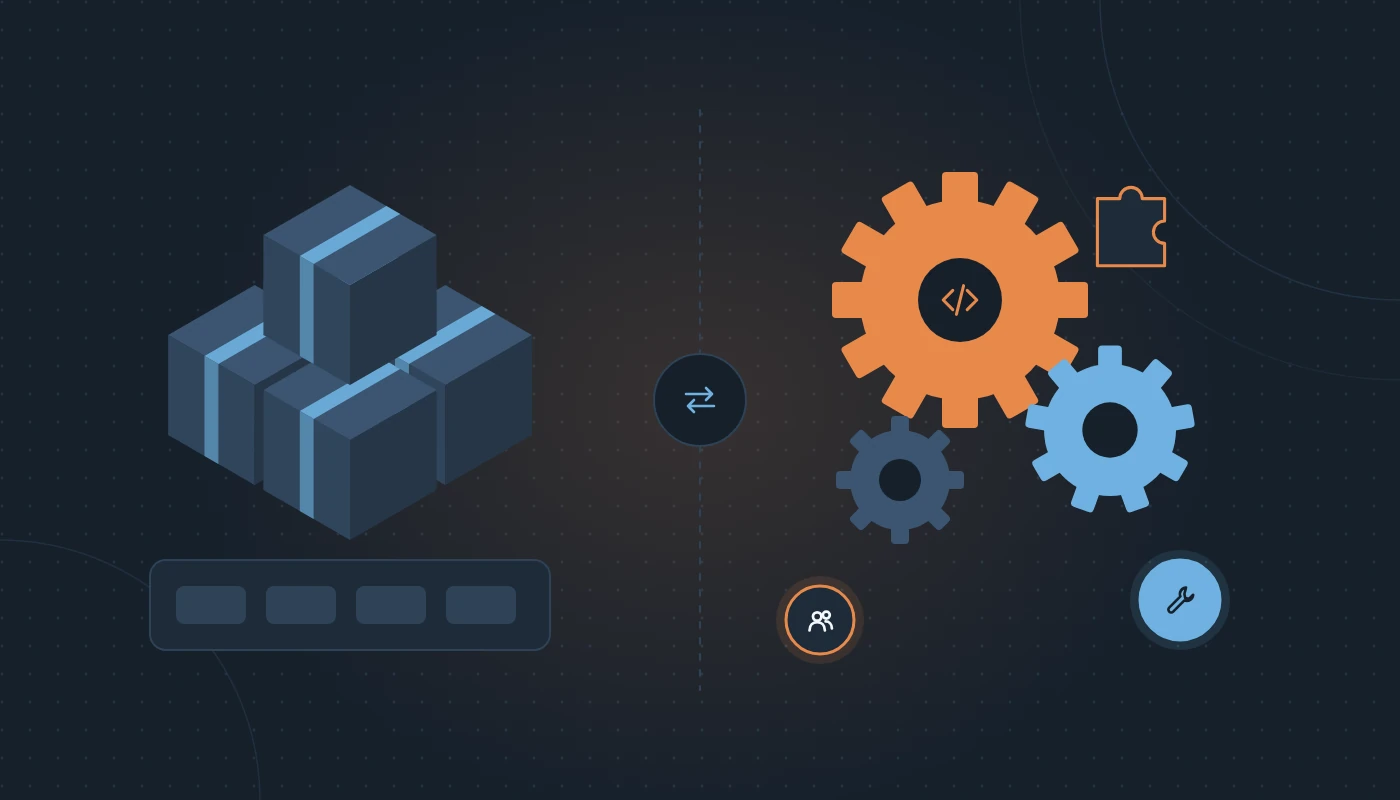
- Custom ERP vs off the shelf: a side-by-side view
- When custom ERP solutions make sense
- The hybrid approach: packaged core plus custom modules
- Building a Laravel ERP system: what to expect
- Should you build your own ERP? Five questions
- Replacing an old custom system
- Cost factors to compare (without the guesswork)
- Four myths that distort the decision
- Contracts, ownership and maintenance
- FAQ
- Conclusion
At some point in most ERP selection projects, someone in the room says: “None of these systems fits how we work. Why don’t we just build our own?” It is a reasonable question. Custom ERP solutions promise a perfect fit, full ownership and no compromises. Off-the-shelf platforms promise speed, proven processes and a vendor who keeps the software current.
Both promises are partly true. This article gives Egyptian business leaders a clear decision framework, explains the hybrid approach most successful companies actually use, and looks honestly at what building a custom system, including on frameworks such as Laravel, involves over the long run.
Why the question keeps coming up
The “build versus buy” debate is especially common in Egypt for a few reasons.
First, many businesses here have grown fast on a patchwork of spreadsheets and small tools, often including a homegrown system built years ago by a developer who has since left. The owners have seen custom software work, at least for a while.
Second, Egyptian companies often run unusual combinations of activities under one group: trading, contracting, property and services, across mainland and free zone entities. Packaged ERPs designed for a single industry can feel awkward.
Third, there is a large local software development market. Finding a team willing to build an ERP is easy. Finding one that will still be supporting it in eight years is harder.
Understanding those drivers helps you separate a genuine need for custom software from frustration with a poor demo or a badly scoped implementation.
Off-the-shelf ERP: what you actually get
“Off-the-shelf” does not mean “unchangeable”. Modern platforms such as Odoo, Dynamics 365 Business Central, SAP Business One and NetSuite are designed to be configured and extended. When you buy one, you get:
- Proven core processes for accounting, purchasing, sales, inventory, HR and reporting, tested by thousands of companies.
- Ongoing updates for security, new features and regulatory changes, including Egypt VAT and, increasingly, e-invoicing support.
- An ecosystem of partners, consultants, add-ons and trained users you can hire.
- Configuration tools to adapt workflows, fields, approvals and reports without writing code.
- Extension frameworks for custom modules where configuration is not enough.
The trade-off is that you adapt some of your processes to the software. Often that is a benefit, because standard processes reflect good practice. Sometimes it is a genuine loss, especially when your process is a real competitive advantage. You can explore what packaged platforms offer on our ERP software Cairo overview, and our article on the advantages of ERP for Egyptian businesses covers the benefits in more depth.
What a custom ERP system really involves
A custom ERP system is software designed and built specifically for your organisation, usually by an in-house team or an external development partner. You own the code (if your contract says so), you decide every screen, and nothing exists that you did not ask for.
That last point cuts both ways. In a packaged ERP, features such as multi-currency revaluation, VAT return reports, audit trails, user permissions, period closing and bank reconciliation already exist. In a custom build, each must be specified, designed, built, tested and maintained.
The ERP system development lifecycle
Serious ERP system development follows the same stages as any large software project, with higher stakes because finance and operations depend on it:
- Discovery and requirements. Mapping every process, document, report, approval and integration. For an ERP, this is weeks of workshops, not a single meeting.
- Architecture. Data model, security model, integration approach, hosting and scalability.
- Design. Screens, workflows and user experience, ideally tested with real users.
- Build in iterations. Typically module by module: masters and finance first, then purchasing, inventory, sales and so on.
- Testing. Functional, integration, performance, security and user acceptance testing, including accounting accuracy.
- Data migration and go-live. Exactly the same challenge as with a packaged ERP.
- Support and evolution. Bug fixes, regulatory changes, new features, security patching and infrastructure upgrades, for the life of the system.
Stage seven is the one most business cases underestimate. Your custom ERP becomes a product with one customer: you.
Custom ERP vs off the shelf: a side-by-side view
Here is a balanced custom ERP vs off the shelf comparison across the factors that matter most to Egyptian businesses.
| Factor | Off-the-shelf ERP | Custom ERP |
|---|---|---|
| Time to first go-live | Shorter; core modules exist | Longer; everything is built |
| Process fit | Good for standard processes; gaps closed by configuration or extensions | Potentially exact, if requirements are right |
| Regulatory updates (VAT, Corporate Tax, e-invoicing) | Usually delivered by vendor or localisation partner | Your responsibility to build and maintain |
| Delivery risk | Moderate; mainly configuration and change management | Higher; scope, design and build risk |
| Vendor dependency | On the software vendor and implementation partner | On the development team that knows the code |
| Talent availability | Large pool of trained consultants and users | Limited to people who know your system |
| Ownership | Licence or subscription; you own your data | You can own the code and IP, if contracted |
| Total cost model | Licences or subscriptions, implementation, support | Build effort, hosting, ongoing development and support |
| Long-term flexibility | Bounded by platform, but platform keeps evolving | Unlimited in theory; constrained by budget and team |
Neither column wins outright. The right choice depends on how standard your processes are and how much of your value lies in the parts that are not.
When custom ERP solutions make sense
Custom ERP solutions are the right call in a narrower set of situations than many people expect, but those situations are real.
Your core process is your product
A logistics start-up whose pricing and dispatch engine is its competitive edge, a specialised manufacturer with unique production planning, or a fintech with unusual transaction flows may find packaged ERPs simply do not model their core business. In these cases, the “ERP” is really an operational platform, and building it is a strategic investment.
You operate in a niche no platform serves
Some Egyptian sectors, for example certain government-linked service models, specialist marine services or unusual franchise structures, have processes no mainstream ERP handles well even with extensions.
You need a platform you will sell or license
If you plan to turn your system into a product for other companies, owning the code is essential.
You have the capability to run it
Custom only works long term if you have, or contract for, a stable product owner and development team. Without that, a custom system becomes a liability within a few years.
For businesses that tick these boxes, a specialist custom software development company can build the operational core while you decide which commodity functions (accounting, payroll) to keep on packaged tools.
The hybrid approach: packaged core plus custom modules
In our experience, the most successful Egyptian companies rarely choose pure custom or pure packaged. They pick a hybrid:
- A packaged ERP core handles finance, VAT, purchasing, inventory, HR and reporting, the areas where standard processes are fine and regulation changes often.
- Custom modules or applications handle what genuinely differentiates the business, built either inside the ERP’s extension framework or as separate applications connected by APIs.
Three hybrid examples
A contracting company in Alexandria used a packaged ERP for finance, procurement and payroll, then built a custom site-progress app for engineers to log daily progress, photos and material usage. The app feeds quantities into the ERP for job costing.
A medical equipment distributor in Cairo Healthcare City kept standard ERP sales and inventory but built a custom module for tracking equipment serial numbers, service contracts and preventive maintenance visits, inside the ERP itself.
A tourism operator in Maadi kept accounting and HR in a packaged system and built a custom booking and fleet-allocation platform, integrated nightly for revenue and commissions.
In each case, the custom piece was small, focused and owned by someone accountable. The packaged core absorbed VAT changes, Corporate Tax reporting needs and e-invoicing preparation without any custom rework.
Making a hybrid work depends on solid ERP customization practice: building extensions the platform’s way, documenting them, and keeping them compatible with upgrades.
Building a Laravel ERP system: what to expect
Laravel, the PHP framework, is a popular choice for custom business applications in Egypt, and searches for a Laravel ERP system reflect that. There are good reasons: a large developer community, mature tooling, strong support for APIs, authentication and queues, and a relatively gentle learning curve.
A Laravel-based ERP can work well when:
- The scope is focused, for example operations, job management or a portal, rather than a full replacement for accounting and payroll.
- You have a clear data model and a disciplined development team.
- You plan for testing, documentation and code reviews from day one.
Watch for these risks:
- Reinventing accounting. Double-entry bookkeeping, VAT reports, multi-currency, period locks and audit trails are hard to get right. Many teams integrate Laravel apps with a packaged accounting system instead of building a ledger.
- Key-person dependency. If one developer understands the system, you are exposed.
- Package sprawl. Third-party packages speed development but need maintaining as Laravel and PHP versions move on.
- Security. Role-based access, encryption, logging and regular testing must be designed in, not added later.
If Laravel is your preferred stack, work with an experienced Laravel development company that can show you real business applications it has supported for several years, not only new builds.
Should you build your own ERP? Five questions
Before you decide to build your own ERP, answer these honestly with your leadership team:
- Which processes are truly unique? List them. If the list is mostly finance, purchasing and stock, a packaged ERP almost certainly fits.
- Who will own the system in five years? Name the role, not just the vendor.
- How will you handle regulatory change? Egypt VAT, Corporate Tax at 22.5% and the e-invoicing programme all require system updates. Who builds those, and how quickly?
- What happens if the developer leaves or the partner closes? Do you own the code, documentation and deployment scripts?
- Have you seen a properly configured packaged ERP? Many “nothing fits” conclusions come from generic demos. A tailored demo using your scenarios can change minds.
An independent ERP consultant Egypt can facilitate this exercise, map your requirements against packaged platforms and highlight where custom development would genuinely add value. For a structured selection process, our buyer’s guide to choosing ERP software in Egypt walks through each step.
Replacing an old custom system
Many Egyptian businesses are not choosing for the first time. They already run a homegrown system, sometimes fifteen or twenty years old, built in a technology few developers still use. The question is whether to rebuild it in modern technology or move to a packaged ERP.
Consider these signals:
| Signal | Suggests rebuilding custom | Suggests moving to packaged ERP |
|---|---|---|
| Core processes | Genuinely unique and valuable | Mostly standard finance and operations |
| Original developer | Still available and engaged | Gone, with little documentation |
| Regulatory gaps | Few, and easy to add | VAT, Corporate Tax and e-invoicing require major changes |
| User satisfaction | High; system fits well | Low; many workarounds in Excel |
| Integration needs | Limited | Growing, with banks, e-invoicing, eCommerce and BI |
A phased legacy system modernization programme often works best: move finance and compliance to a packaged ERP first, then retire, rebuild or integrate the remaining custom functions one by one. This reduces risk compared with a single “big bang” replacement.
Cost factors to compare (without the guesswork)
Comparing costs between custom and packaged options is notoriously misleading, because the two models spend money at different times. A packaged ERP spreads cost across licences or subscriptions, implementation and support. A custom build concentrates cost up front in development, then continues indefinitely through maintenance and enhancement.
When you build your business case, compare the same factors over the same period, ideally five to seven years:
- Initial effort. Configuration and implementation for packaged; design, build and testing for custom.
- Licensing or ownership model. Per-user subscriptions, perpetual licences with maintenance, or hosting and infrastructure for code you own.
- Regulatory change. Included in vendor updates, or built by your team each time a rule changes.
- Upgrades. Retesting extensions on a packaged platform, versus framework, language and library upgrades on custom code.
- People. Internal key users and administrators for both; developers and a product owner for custom.
- Risk contingency. Custom projects carry more scope and schedule uncertainty, so allow for it.
- Exit cost. What it takes to move away later, whichever path you choose.
Laying the factors out like this usually reveals that the real difference is not the starting figure but who carries the long-term risk.
Four myths that distort the decision
“Custom is always cheaper because there are no licences.” Licences disappear, but development, hosting, security and support do not. Over time, these often outweigh licence savings.
“Packaged ERP means we must change everything we do.” Most platforms can be configured extensively. Gaps are usually small and can be closed with targeted extensions.
“We will own it, so we will control it.” You control it only while you have the people who understand it. Ownership without capability is not control.
“We can always switch later.” Switching from either path is a major project. Choose with a long horizon in mind.
Contracts, ownership and maintenance
If you do commission custom development, the contract matters as much as the code.
- Intellectual property. Make sure you own the source code and have the right to modify it with another provider.
- Source code escrow or repository access. You should have access to the repository at all times, not just at the end of the project.
- Documentation. Require technical and user documentation as deliverables, not optional extras.
- Support terms. Define response times, bug-fix obligations and how enhancements are requested and prioritised.
- Exit plan. Agree how knowledge will be transferred if the relationship ends.
These points also apply to custom modules built on a packaged ERP. Ownership of extensions should be clear from the start.
Frequently asked questions
Are custom ERP solutions better than off-the-shelf ERP?
Not inherently. Custom ERP is better when your core processes are unique and you can support the system long term. Off-the-shelf ERP is better for standard finance, purchasing, inventory and HR processes. Most businesses get the best result from a hybrid.
How long does custom ERP system development take?
It depends on scope. A focused operational module can be delivered in months; a full ERP replacing finance, inventory, sales and HR typically takes considerably longer than implementing a packaged platform, because every function must be built and tested.
Is a Laravel ERP system a good idea?
Laravel is a solid framework for custom business applications. It works best for focused operational systems, often integrated with packaged accounting software. Building complete accounting and payroll in Laravel is possible but carries more risk and maintenance effort.
Can I build your own ERP style system on top of Odoo or another platform?
Yes. Many companies build custom modules inside a packaged ERP’s extension framework, which combines a proven core with tailored functionality. This is often the lowest-risk way to get a close fit.
Who maintains a custom ERP after go-live?
You do, either through an in-house team or a development partner under a support agreement. Plan for bug fixes, security updates, regulatory changes and new features for as long as you use the system.
Will a custom ERP handle Egyptian e-invoicing?
Only if you build it to. Your system will need to generate structured invoices and connect to an Accredited Service Provider, and to keep up as specifications evolve. Packaged platforms and their partners typically handle this as part of their updates.
Conclusion
Custom ERP solutions earn their place when your core process is your competitive edge and you have the long-term capability to own the software. For everything else, a packaged ERP gives you speed, proven processes and regulatory updates you do not have to build yourself.
The smartest approach for most Egyptian businesses is a hybrid: a packaged core for finance, compliance and standard operations, with focused custom modules where they create real value. Decide with clear eyes about ownership, maintenance and regulatory change, and the choice becomes much easier. For more practical ERP reading, visit our ERP blog.